

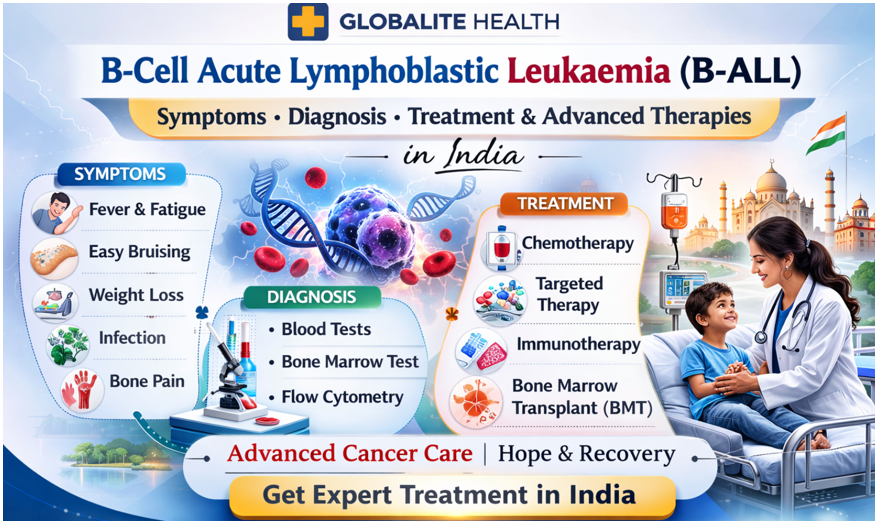
B-Cell Acute Lymphoblastic Leukemia (B-ALL) is a fast-growing blood cancer that originates in the bone marrow and affects immature B-lymphocytes. These cells normally help the body fight infections, but in B-ALL, they grow uncontrollably and crowd out healthy blood cells.
Although B-ALL progresses rapidly, it is one of the most treatable forms of leukemia today. With modern treatment approaches including chemotherapy, targeted therapy, immunotherapy, CAR-T cell therapy, and bone marrow transplant (BMT), survival rates have significantly improved.
Early diagnosis and timely treatment are critical for the best outcomes.
What Is B-Cell Acute Lymphoblastic Leukemia (B-ALL)?
B-ALL is a subtype of acute lymphoblastic leukemia (ALL) that arises from lymphoid stem cells in the bone marrow.
In B-ALL:
- Immature B-cells (lymphoblasts) multiply rapidly
- Healthy red blood cells and platelets decrease
- Abnormal cells spill into the bloodstream
- Leukemia may spread to lymph nodes, liver, spleen, and central nervous system (CNS)
Because it is “acute,” the disease progresses quickly and requires urgent treatment.
Causes and Risk Factors of B-ALL
The exact cause of B-ALL is often unknown, but several factors are associated with increased risk.
Genetic Factors
- Chromosomal abnormalities (e.g., BCR-ABL1 / Philadelphia chromosome)
- IKZF1 deletions
- KMT2A rearrangements
- Down syndrome
- Fanconi anemia
Environmental Factors
- High-dose radiation exposure
- Previous chemotherapy or radiation for another cancer
Immune-Related Conditions
- Rare inherited immune deficiency syndromes
However, most cases occur without a clearly identifiable trigger.
Symptoms of B-Cell Acute Lymphoblastic Leukemia
Symptoms usually develop suddenly over days or weeks.
Blood-Related Symptoms
- Persistent fatigue
- Pale skin (anemia)
- Shortness of breath
- Recurrent infections
- Fever without clear cause
Bleeding Symptoms
- Easy bruising
- Bleeding gums
- Frequent nosebleeds
- Tiny red skin spots (petechiae)
Bone Marrow Symptoms
- Bone pain (especially legs and hips)
- Joint pain
- Back pain
Other Symptoms
- Swollen lymph nodes
- Enlarged liver or spleen
- Weight loss
- Loss of appetite
- Night sweats
- Headache (if CNS involvement)
Children may become irritable or refuse to walk due to bone pain.
When Should You Seek Medical Evaluation?
Immediate evaluation by a hematologist is advised if:
- Fever persists for more than 2 weeks
- Unusual bruising or bleeding occurs
- Severe fatigue and breathlessness develop
- Swollen lymph nodes appear
- Routine CBC shows abnormal results
- A child suddenly refuses to walk due to leg pain
Early diagnosis improves survival dramatically.
How Is B-ALL Diagnosed?
Diagnosis involves several precise tests.
1️⃣ Complete Blood Count (CBC)
May show:
- Low hemoglobin
- Low platelets
- Abnormal white blood cell count
- Presence of blasts
2️⃣ Peripheral Blood Smear
Examines abnormal cells under a microscope.
3️⃣ Bone Marrow Biopsy
Confirms diagnosis and measures blast percentage.
4️⃣ Flow Cytometry
Identifies B-cell markers:
- CD19
- CD10
- CD22
- CD34
- TdT
5️⃣ Cytogenetic & Molecular Testing
Detects:
- BCR-ABL1 (Philadelphia chromosome)
- TEL-AML1 fusion
- Hyperdiploidy
- IKZF1 deletion
- KMT2A rearrangements
These results determine risk category and guide treatment.
6️⃣ Lumbar Puncture
Checks for CNS involvement.
Types of B-ALL
- Standard-Risk B-ALL
- Favourable genetics
- Excellent response to treatment
- High-Risk B-ALL
- High WBC count
- Poor early response
- High-risk genetic mutations
- Philadelphia Chromosome-Positive (Ph+ B-ALL)
- Requires targeted therapy (TKIs)
- Philadelphia-Like (Ph-Like) B-ALL
- High-risk subtype
- Needs aggressive management
Treatment of B-Cell Acute Lymphoblastic Leukaemia
Treatment is delivered in multiple phases and may last 2–3 years in children.
Phase 1: Induction Therapy (First 4 Weeks)
Goal: Achieve complete remission.
Drugs include:
- Vincristine
- Steroids
- Asparaginase
- Anthracyclines
Remission rates:
- Children: 80–95%
- Adults: 70–85%
Phase 2: Consolidation / Intensification
Goal: Eliminate residual leukaemia cells.
Drugs may include:
- High-dose Methotrexate
- Cytarabine
- Cyclophosphamide
- Etoposide
Phase 3: CNS Prophylaxis
Prevents spread to the brain and spinal cord.
Methods:
- Intrathecal chemotherapy
- Rarely cranial radiation
Phase 4: Maintenance Therapy
Duration: 18–24 months
Goal: Prevent relapse.
Medicines:
- 6-Mercaptopurine
- Methotrexate
- Periodic Vincristine
Advanced & Targeted Therapies
Tyrosine Kinase Inhibitors (TKIs)
Used in Ph+ B-ALL.
Examples:
- Imatinib
- Dasatinib
- Ponatinib
Immunotherapy
Blinatumomab
Targets CD19 and redirects T-cells.
Inotuzumab Ozogamicin
Targets CD22-positive leukaemia cells.
These therapies improve survival in relapsed or MRD-positive disease.
CAR-T Cell Therapy in B-ALL
CAR-T cell therapy is considered when:
- Disease does not respond to chemotherapy
- Early relapse occurs
- Relapse after stem cell transplant
- Persistent minimal residual disease (MRD)
- High-risk genetic subtype
CAR-T has demonstrated very high remission rates in patients with refractory B-ALL.
Bone Marrow Transplant (BMT) in B-ALL
BMT is recommended for:
- High-risk B-ALL
- Persistent MRD
- Relapsed disease
- Poor response to induction therapy
- Ph+ B-ALL with inadequate TKI response
Types of transplant:
- Matched sibling donor
- Matched unrelated donor
- Haploidentical transplant
Prognosis and Survival Rates
Prognosis depends on:
- Age
- Genetic subtype
- MRD status
- Early treatment response
Children:
- Cure rates: 80–90%
Adults:
- Improving survival due to TKIs, immunotherapy, CAR-T, and advanced transplant techniques
Frequently Asked Questions
Is B-ALL curable?
Yes. Many children and some adults achieve a complete cure with proper treatment.
How long does B-ALL treatment take?
Treatment usually lasts 2–3 years in children and slightly shorter in adults.
What is Minimal Residual Disease (MRD)?
MRD refers to small numbers of leukaemia cells that persist after treatment and may lead to relapse.
When is a bone marrow transplant required?
In high-risk, relapsed, or chemotherapy-resistant cases.
What are the latest treatments for B-ALL?
Targeted therapy (TKIs), immunotherapy (Blinatumomab), CAR-T cell therapy, and advanced transplant protocols.