

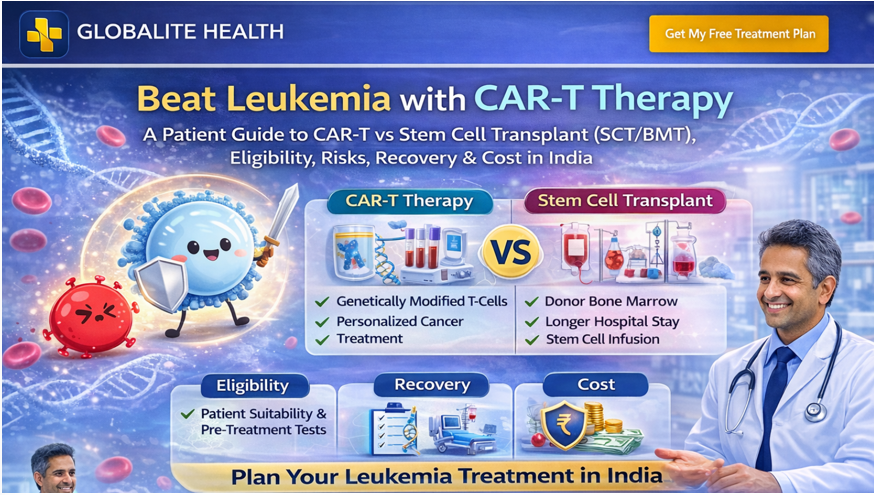
Blood cancers like leukaemia, lymphoma, and multiple myeloma can feel overwhelming—especially when the disease returns (relapse) or stops responding to standard treatment (refractory). The good news is that modern therapies such as CAR-T cell therapy and Stem Cell Transplant (SCT/Bone Marrow Transplant – BMT) are transforming outcomes and offering renewed hope.
This blog explains—clearly and practically—how CAR-T works, how it compares to BMT, when each is recommended, what recovery looks like, and how India is making these advanced treatments more accessible.
What Is CAR-T Therapy?
CAR-T (Chimeric Antigen Receptor T-Cell) Therapy is a powerful form of immunotherapy that uses your own immune cells to fight cancer.
In simple words: Your T-cells are trained in a lab to recognise and kill leukaemia cells, then infused back into your body to attack the cancer.
CAR-T has shown strong efficacy in relapsed/refractory B-cell malignancies, especially B-cell acute lymphoblastic leukaemia (B-ALL). The FDA has approved multiple CD19-directed CAR-T products for the treatment of relapsed/refractory B-cell precursor ALL in adults.
How CAR-T Therapy Works (Step-by-Step)
1) T-Cell Collection (Leukapheresis)
Blood is passed through a machine that collects T-cells, then returns the rest of the blood to you.
2) CAR-T Manufacturing (Lab Engineering)
Your T-cells are genetically modified to recognise a target on cancer cells (commonly CD19 in B-cell leukaemias/lymphomas).
3) Short “Bridging” Treatment (If Needed)
Some patients receive chemotherapy or targeted therapy while CAR-T is being prepared.
4) Lymphodepleting Chemotherapy
A short chemo course prepares your body to accept and expand CAR-T cells.
5) CAR-T Infusion (Usually One-Time)
CAR-T cells are infused like a blood transfusion.
6) Close Monitoring & Recovery
Patients are monitored closely for side effects, especially during the first 1–2 weeks.
Who Is CAR-T Therapy Best For?
CAR-T is commonly recommended for:
- Relapsed or refractory B-cell Acute Lymphoblastic Leukaemia (B-ALL)
- Certain Non-Hodgkin Lymphomas (B-cell types)
- Multiple Myeloma (in specific settings)
CAR-T is often considered when:
- Leukaemia returns after chemotherapy
- Leukaemia doesn’t respond to chemotherapy
- Disease returns after a stem cell transplant
- MRD (Minimal Residual Disease) remains positive despite treatment
Clinical studies in pediatric/young adult patients with relapsed/refractory B-ALL have shown high remission rates with CAR-T (e.g., tisagenlecleucel trials reported an overall remission rate of approximately 81% in key analyses).
What Is a Stem Cell Transplant (SCT/BMT)?
A Stem Cell Transplant (Bone Marrow Transplant) replaces diseased bone marrow with healthy blood-forming stem cells.
Types of Transplant
- Autologous SCT: your own stem cells (common in myeloma, some lymphomas)
- Allogeneic SCT: stem cells from a donor (often used in leukaemia; can be curative)
BMT can cure many blood cancers—but it is more intensive and often requires a longer recovery, especially with donor transplants.
CAR-T vs BMT: What’s the Difference?
CAR-T Therapy (Immunotherapy)
- Uses your modified T-cells to kill cancer
- Usually a single infusion
- Best for relapsed/refractory B-cell cancers
- Key risks: CRS and ICANS (neurologic toxicity)
BMT / SCT (Transplant)
- Replaces bone marrow with new stem cells
- Often used for high-risk leukaemia, relapse prevention, or cure
- Key risks: infections, organ toxicity, and in donor transplants, GVHD
Side Effects You Should Know
CAR-T Side Effects (Most Important)
1) Cytokine Release Syndrome (CRS)
CRS can cause fever, low blood pressure, breathing issues, and fatigue. It’s graded using widely adopted consensus systems (ASTCT).
Treatment may include supportive care and medications such as tocilizumab, which has FDA approval for severe CRS associated with CAR-T.
2) ICANS (Neurologic Toxicity)
Confusion, speech issues, tremors, seizures (less common). Monitoring is essential.
3) Low Blood Counts & Infections
Temporary immunosuppression is common.
BMT Side Effects (Most Important)
- Infections during immune recovery
- Graft-Versus-Host Disease (GVHD) in donor transplants
- Organ toxicities (liver, lungs, heart)
- Longer recovery and follow-up requirements
Recovery Timeline: CAR-T vs BMT
After CAR-T
- Monitoring in hospital often ~1–2 weeks (varies by patient/hospital)
- Highest risk period: first 2–4 weeks
- Some patients need caregiver support for weeks after discharge
After BMT
- Hospital stay is often several weeks
- Immune recovery takes months
- Longer infection precautions and follow-up (especially allogeneic BMT)
CAR-T Therapy in India: Why Patients Choose It
India is increasingly recognised for advanced blood cancer care, including CAR-T and transplant programs.
Key advantages:
- Expert hematologists & transplant teams
- International-standard monitoring protocols
- More affordable access compared to many countries
- Availability of India-manufactured CAR-T options
India’s first homegrown CAR-T, NexCAR19 (actalycabtagene autoleucel), was developed through collaboration involving IIT Bombay and Tata Memorial Hospital and manufactured for broader access.
India has also seen additional CAR-T offerings, such as Qartemi (varnim-cel) for CD19-positive B-cell malignancies, manufactured in India.
Note: Eligibility and suitability vary—CAR-T is not “for everyone,” and the best option depends on disease subtype, prior treatment response, and overall fitness.
When CAR-T Is Preferred vs When BMT Is Preferred
CAR-T is often preferred when:
- Leukaemia is relapsed/refractory
- Disease persists despite chemotherapy
- Relapse occurs after transplant
- Patient needs a targeted option where chemo is failing
BMT is often preferred when:
- Leukaemia is high-risk and needs curative consolidation
- A strong donor option exists, and the transplant is medically suitable
- Disease biology suggests better long-term cure probability with transplant
- CAR-T is not available/appropriate for the cancer type
In real practice, CAR-T and BMT can be used sequentially (example: CAR-T to achieve remission, followed by transplant in selected high-risk cases).
Questions to Ask Before Choosing CAR-T or BMT
- What is my exact diagnosis (B-ALL, AML, lymphoma subtype)?
- Is the disease relapsed or refractory?
- What is my MRD status?
- Am I fit for intensive therapy?
- Do I have a matched donor (if transplant is needed)?
- What are the expected benefits and risks for my case?
- What monitoring and ICU support is available if CRS occurs?
- What is the total cost estimate, including hospital stay and follow-ups?
Conclusion
CAR-T therapy is changing the leukaemia story—especially for patients with relapsed or refractory B-cell leukaemia—by offering a powerful immune-based treatment that can deliver deep remissions when other therapies fail. Stem cell transplant remains a proven, potentially curative option for many high-risk blood cancers and genetic blood disorders.
The best choice depends on disease type, risk profile, response to prior therapy, donor availability, and your overall health. A haematologist’s evaluation is essential to decide the safest and most effective path.
Frequently Asked Questions
Which treatment is better—CAR-T therapy or stem cell transplant?
Neither is “better” for everyone. CAR-T is often best for relapsed/refractory B-cell cancers; BMT is often best as curative consolidation in high-risk disease or when donor transplant offers the highest cure chance.
Can CAR-T replace stem cell transplant?
In some patients, CAR-T may reduce or delay the need for transplant. In others, transplant may still be recommended after CAR-T—especially if relapse risk remains high.
How long does recovery take after CAR-T vs transplant?
CAR-T recovery is often weeks, while transplant recovery is often months (especially for donor transplants).
Is CAR-T therapy painful?
The infusion itself is usually not painful. The main challenge is managing side effects like fever (CRS) and temporary weakness, which require close monitoring.
Are donor stem cells necessary?
Only for an allogeneic transplant. CAR-T uses your own cells; an autologous transplant also uses your own stem cells.
Are CAR-T and BMT available internationally?
Yes—many countries offer both, but access and cost vary widely. India is becoming a key destination due to affordability and the growing availability of CAR-T and transplant services.
Does insurance cover CAR-T and BMT?
Coverage depends on your country and insurer. Many patients request a hospital estimate and a pre-authorisation letter before travel.