

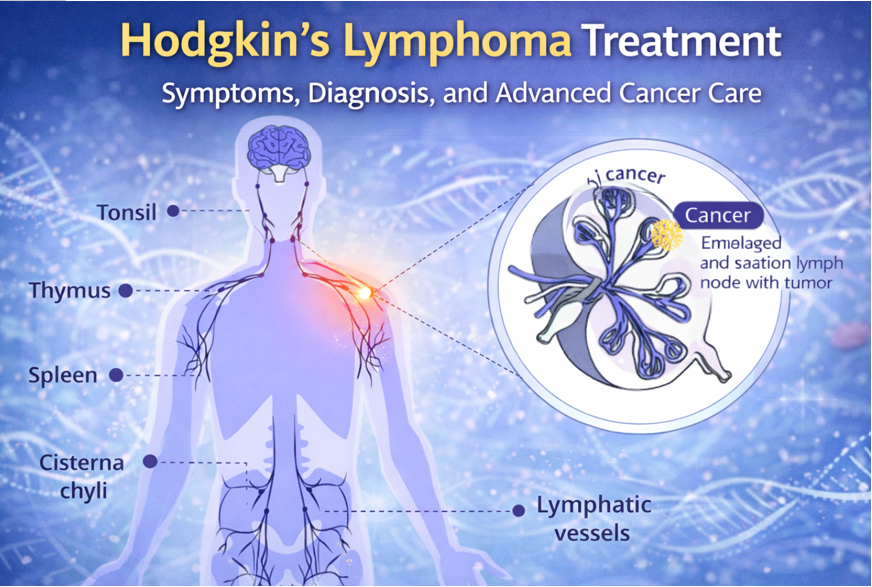
Hodgkin’s Lymphoma (also called Hodgkin lymphoma) is a cancer that starts in the lymphatic system—part of your immune system. The good news: it is one of the most treatable cancers, especially when diagnosed early and treated with the right protocol.
Many international patients—especially from Kenya, Ghana, Ethiopia, Uganda, Cameroon, Tanzania, and nearby countries—choose Hodgkin’s lymphoma treatment in India because it offers advanced diagnostics (PET-CT), modern chemotherapy, immunotherapy, and stem cell transplant facilities at a more affordable overall cost.
What Is Hodgkin’s Lymphoma?
Hodgkin’s Lymphoma is a type of blood cancer in which abnormal lymphocytes (white blood cells) grow out of control, usually starting in a lymph node (often in the neck or chest) and sometimes spreading to other lymph nodes or organs.
What makes Hodgkin’s lymphoma different from Non-Hodgkin lymphoma?
The diagnosis is confirmed by finding Reed–Sternberg cells (a specific abnormal cell type) in a lymph node biopsy.
Types of Hodgkin’s Lymphoma
Doctors generally classify Hodgkin’s lymphoma into:
1) Classical Hodgkin Lymphoma (cHL) — most common
Includes common subtypes such as:
- Nodular sclerosis
- Mixed cellularity
- Lymphocyte-rich
- Lymphocyte-depleted
2) Nodular Lymphocyte-Predominant Hodgkin Lymphoma (NLPHL) — less common
Often slower growing and may have a different treatment strategy.
Warning Signs and Symptoms of Hodgkin’s Lymphoma
Hodgkin’s lymphoma can begin quietly. Many patients notice only one symptom at first.
Common early symptoms
- Painless swollen lymph nodes (neck, underarm, groin)
- Persistent cough / shortness of breath (if chest nodes are involved)
- Itching (pruritus) without a clear skin rash
- Feeling full quickly (enlarged spleen)
“B symptoms” (important clinical red flags)
These symptoms can affect staging and treatment intensity:
- Unexplained fever
- Drenching night sweats
- Unintentional weight loss (more than 10% over 6 months)
When to see a doctor
If a lymph node is swollen for more than 2 weeks, or you have fever/night sweats/weight loss together, consult a hematologist urgently.
How Is Hodgkin’s Lymphoma Diagnosed?
A correct diagnosis and staging plan is the foundation of successful treatment.
Step 1: Clinical exam + history
Your doctor checks lymph nodes and reviews symptoms (fever, weight loss, itching, fatigue).
Step 2: Blood tests (supportive)
- CBC (blood counts)
- ESR/CRP (inflammation)
- Liver/kidney function (treatment safety)
- LDH (can reflect disease activity)
Step 3: Lymph node biopsy (confirmatory test)
This is the key test. An excisional biopsy (whole node) is often preferred because it gives the most accurate diagnosis and subtype.
Step 4: PET-CT / CT scans (staging)
PET-CT is commonly used to:
- Map disease spread
- Decide stage (I–IV)
- Assess response after treatment
Step 5: Bone marrow biopsy (only if needed)
Often considered in more advanced cases or if blood counts are significantly low.
Hodgkin’s Lymphoma Treatment Options
Treatment depends on:
- Stage (I–IV)
- Presence of B symptoms
- Bulk disease (large masses)
- Age, fitness, and organ function
1) Chemotherapy (main treatment)
Chemotherapy is the backbone of Hodgkin’s lymphoma care.
ABVD is one of the most widely used first-line regimens (Adriamycin, Bleomycin, Vinblastine, Dacarbazine).
Other regimens may be used in selected higher-risk cases based on your oncologist’s plan.
2) Radiation therapy (in selected cases)
Often used:
- In early-stage disease after chemo
- To treat localized bulky nodes
Modern techniques aim to protect heart/lungs as much as possible.
3) Targeted therapy
Used mainly in relapsed/refractory disease or special situations:
- Brentuximab vedotin (targets CD30 in many classical HL cases)
4) Immunotherapy (Checkpoint inhibitors)
For relapsed or resistant Hodgkin’s lymphoma:
- Nivolumab or Pembrolizumab can help the immune system attack cancer cells.
5) Stem Cell (Bone Marrow) Transplant
Usually considered when:
- Hodgkin’s lymphoma returns after first-line therapy
- Disease is refractory (doesn’t respond well)
Autologous transplant (patient’s own stem cells) is commonly used in Hodgkin’s lymphoma.
Why Choose India for Hodgkin’s Lymphoma Treatment?
Patients from Africa often choose India for:
- Fast diagnosis (biopsy + PET-CT) and treatment start
- Access to modern chemo, immunotherapy, and transplant programs
- Experienced hematology/oncology teams
- Transparent packages and international patient support (visa letters, travel help, coordinators)
Hodgkin’s Lymphoma Treatment Cost in India (Estimated)
In India, the total cost commonly ranges from $6,000 to $30,000, depending on:
- Stage and risk group
- Number of chemo cycles
- Need for PET-CT scans, radiation, targeted therapy, or transplant
- Hospital category and length of stay
Important: Targeted therapy and immunotherapy can increase cost significantly, especially if multiple doses are needed.
Recovery and Success Rate of Hodgkin’s Lymphoma
Hodgkin’s lymphoma has strong outcomes compared with many other cancers.
- The American Cancer Society reports 5-year relative survival around 89% overall (SEER data; varies by spread at diagnosis).
- Mayo Clinic summarizes stage-based outcomes (example: about 92% for stage 1 and ~82% for stage 4, based on their cited sources).
What recovery looks like
- Many patients regain appetite and energy gradually during and after treatment.
- Follow-up typically includes periodic exams, blood tests, and imaging as advised.
- Long-term monitoring helps detect relapse early and manage late effects (especially after radiation or intensive chemo).
Frequently Asked Questions (FAQs)
1) What are the common symptoms of Hodgkin’s Lymphoma?
Painless swollen lymph nodes (neck/armpit/groin), fever, night sweats, weight loss, fatigue, itching, cough or breathlessness (if chest nodes are involved).
2) What causes Hodgkin’s Lymphoma?
In most cases, the exact cause is not clear. Some associations include immune suppression and prior Epstein–Barr virus infection, but many patients have no obvious risk factor.
3) How is Hodgkin’s Lymphoma diagnosed?
The diagnosis is confirmed by a lymph node biopsy showing Hodgkin-type cells (including Reed–Sternberg cells in classical HL). PET-CT/CT scans are then used for staging.
4) What are the treatment options for Hodgkin’s Lymphoma?
Chemotherapy (often ABVD), radiation in selected cases, targeted therapy (brentuximab), immunotherapy (nivolumab/pembrolizumab) for relapse, and stem cell transplant for relapsed/refractory disease.
5) What is the recovery and success rate for Hodgkin’s Lymphoma?
Overall outcomes are excellent. U.S. SEER-based summaries show about 89% 5-year relative survival overall, with higher survival in localised disease and lower in distant spread.