

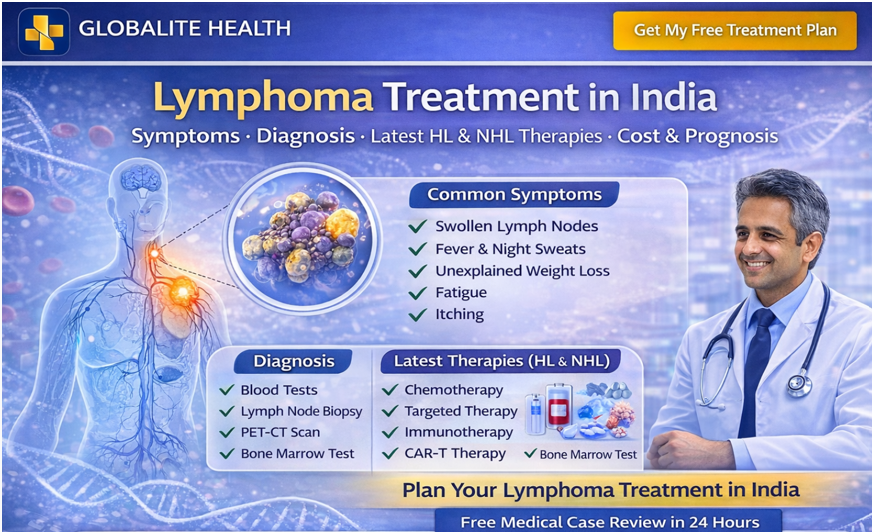
Lymphoma is one of the most treatable blood cancers, especially when diagnosed early and treated by an experienced hematology-oncology team. With rapid progress in PET-CT imaging, immunohistochemistry (IHC), molecular testing, targeted medicines, immunotherapy, CAR-T cell therapy, and bone marrow transplant (BMT), India has become a trusted destination for patients seeking advanced lymphoma treatment at an affordable cost.
In this guide, we explain Hodgkin Lymphoma (HL) and Non-Hodgkin Lymphoma (NHL) in a clear, patient-friendly way—covering causes, symptoms, diagnosis, staging, treatment options, recovery, and success rates—based on widely used international treatment approaches and the kind of clinical pathways followed by leading lymphoma specialists in India.
What Is Lymphoma?
Lymphoma is a type of blood cancer that starts in the lymphatic system—a network of lymph nodes, spleen, bone marrow, thymus, and lymph vessels that helps your body fight infections.
It develops when lymphocytes (a type of white blood cell) grow abnormally and can collect in lymph nodes and other organs.
Two Main Types of Lymphoma
- Hodgkin Lymphoma (HL)
- Non-Hodgkin Lymphoma (NHL)
Hodgkin Lymphoma (HL)
Hodgkin Lymphoma is confirmed by the presence of Reed–Sternberg cells on biopsy.
Key Features
- Commonly affects young adults (15–40) and older adults (55+)
- Often begins in neck or chest lymph nodes
- Highly curable, even in many advanced cases with modern therapy
Main Categories
- Classical Hodgkin Lymphoma (cHL) (most common)
- Nodular Lymphocyte-Predominant HL (NLPHL) (rarer, slower-growing, different management)
Non-Hodgkin Lymphoma (NHL)
NHL is a large group with 60+ subtypes. These range from:
- Indolent (slow-growing) lymphomas (may not need immediate treatment)
- Aggressive (fast-growing) lymphomas (need urgent therapy)
Common NHL Subtypes
- Diffuse Large B-Cell Lymphoma (DLBCL) (most common)
- Follicular Lymphoma
- Mantle Cell Lymphoma
- T-Cell Lymphomas
- Burkitt Lymphoma
Because NHL subtypes behave differently, accurate subtyping is critical before starting treatment.
Causes and Risk Factors of Lymphoma
Lymphoma often develops without a clear cause, but risk may increase with:
- Weakened immunity (HIV, transplant medicines)
- Autoimmune diseases (lupus, rheumatoid arthritis)
- Certain infections (EBV, Hepatitis B/C, HTLV-1—linked with specific subtypes)
- Exposure to chemicals (pesticides, herbicides, industrial solvents)
- Older age (especially for NHL)
- Family history (small increased risk)
Symptoms of Lymphoma
Symptoms vary by location and subtype, but common warning signs include:
Lymph Node Symptoms
- Painless swelling in neck, armpit, or groin
- Feeling of pressure/fullness (especially in chest/abdomen)
“B Symptoms” (Important Red Flags)
- Unexplained fever
- Night sweats (soaking)
- Unintentional weight loss
- Persistent fatigue
Other Symptoms
- Itchy skin (sometimes in HL)
- Chest pain, cough, breathlessness (chest nodes)
- Abdominal pain/bloating, reduced appetite (spleen/liver involvement)
- Frequent infections
- Easy bruising/bleeding (if bone marrow is affected)
✅ If symptoms persist more than 2 weeks, consult a hematologist.
How Lymphoma Is Diagnosed (Step-by-Step)
A correct diagnosis requires multiple tests to confirm type + subtype + stage:
1) Physical Examination
Checking lymph nodes, liver, spleen.
2) Blood Tests
- CBC
- LDH
- ESR/CRP
- Liver/kidney function tests
3) Imaging
- PET-CT (most useful for staging and response assessment)
- CT scan (neck/chest/abdomen/pelvis) if PET-CT not available
4) Lymph Node Biopsy (Most Important Test)
A biopsy confirms lymphoma and helps classify subtype.
- Excisional biopsy (entire node) is often preferred for best accuracy.
5) IHC / Flow Cytometry
Identifies markers (like CD20, CD3, CD30, etc.) to define the exact type.
6) Bone Marrow Biopsy (If Needed)
Checks if lymphoma has involved the marrow (often in advanced stage or abnormal blood counts).
7) Molecular / Genetic Testing (Selective)
FISH / PCR / NGS in certain cases to guide targeted therapy and prognosis.
Stages of Lymphoma
Staging describes how far lymphoma has spread:
- Stage I: One lymph node region (or single organ site)
- Stage II: Two or more lymph node regions on the same side of diaphragm
- Stage III: Lymph nodes on both sides of diaphragm
- Stage IV: Spread to organs like bone marrow, liver, lungs, or CNS
Staging helps determine treatment intensity and expected outcomes.
Latest Lymphoma Treatment Options in India
Treatment depends on:
- HL vs NHL subtype
- Stage
- Patient age/fitness
- Risk markers and response to initial therapy
1) Chemotherapy (Core Treatment)
Hodgkin Lymphoma
- ABVD is one of the most common first-line regimens.
- Escalated BEACOPP may be used in selected advanced/high-risk cases.
Non-Hodgkin Lymphoma
- R-CHOP is commonly used for DLBCL and other B-cell NHLs when indicated.
- Treatment may be adapted for aggressive vs indolent types.
2) Immunotherapy (Major Breakthrough)
For Hodgkin Lymphoma (especially relapsed/refractory)
- PD-1 inhibitors: Nivolumab, Pembrolizumab
For Non-Hodgkin Lymphoma
- Monoclonal antibodies: Rituximab, Obinutuzumab (subtype-based)
- Newer options include bispecific antibodies in selected cases
- CAR-T cell therapy in relapsed/refractory aggressive B-cell lymphomas (in selected centers)
3) Targeted Therapy
Targeted drugs act on specific pathways and are used based on subtype and prior therapy, for example:
- Ibrutinib / Acalabrutinib (BTK inhibitors)
- Venetoclax
- Lenalidomide
- PI3K inhibitors (select situations)
These can be particularly useful in relapsed/refractory NHL and specific subtypes.
4) Radiation Therapy
Radiation may be used in:
- Early-stage HL
- Localized NHL
- Residual/bulky disease after chemotherapy
Advanced techniques (IMRT/IGRT) improve precision and reduce side effects.
5) Bone Marrow Transplant (BMT) / Stem Cell Transplant
Used when lymphoma is:
- Relapsed
- Refractory
- High-risk and needing consolidation
Types
- Autologous BMT: patient’s own stem cells (common in relapsed HL/NHL)
- Allogeneic BMT: donor stem cells (selected high-risk cases)
6) CAR-T Cell Therapy (Future-Defining Option)
CAR-T is considered a game-changer for relapsed or refractory aggressive B-cell NHL in eligible patients.
How it works (simple):
- T-cells are collected → engineered in a lab → infused back to attack lymphoma cells.
7) Watchful Waiting (For Some Slow-Growing NHL)
For indolent lymphomas (e.g., some follicular lymphomas) with no symptoms, doctors may monitor closely and start treatment only when needed.
Lymphoma Treatment Cost in India (Estimated)
Costs vary based on subtype, stage, drug choice, hospital, ICU needs, and whether transplant/CAR-T is required.
Typical broad ranges (approximate):
- Standard chemo + scans: $6,000 – $30,000 (varies widely)
- Targeted therapy / immunotherapy: can increase cost depending on doses
- Stem cell transplant: can raise total cost further
If you share the biopsy/IHC report + PET-CT summary, a more accurate estimate can be structured.
Survival Rates and Prognosis
Hodgkin Lymphoma
- Generally very high cure rates, especially in early stages.
- Even advanced HL often responds well with modern therapy.
Non-Hodgkin Lymphoma
- Prognosis depends strongly on subtype + stage + response to treatment.
- Aggressive lymphomas can be curable; indolent lymphomas can often be controlled long-term.
Lifestyle, Diet and Supportive Care During Treatment
Good supportive care improves recovery:
- High-protein, balanced diet (as tolerated)
- Infection prevention (hand hygiene, mask in crowded areas if advised)
- Light activity and walking (if approved)
- Mental health support and counseling
- Vaccinations post-therapy (as advised by your treating team)
Expert Insight: What Matters Most in Lymphoma Treatment
The most important success factors are:
- Accurate biopsy + subtype classification
- Correct staging (PET-CT when possible)
- Evidence-based protocol selection
- Supportive care + monitoring
- Early use of advanced options when needed (targeted therapy, immunotherapy, BMT, CAR-T)
Conclusion
Lymphoma—both Hodgkin and Non-Hodgkin—is among the most treatable blood cancers today. With timely diagnosis, correct subtyping, and modern treatment planning, many patients achieve complete remission and return to normal life.
India offers a strong combination of advanced lymphoma care and affordability, including access to immunotherapy, targeted therapy, stem cell transplants, and CAR-T at selected centres.
If you or a loved one has suspected or confirmed lymphoma, early consultation with a lymphoma specialist can significantly improve outcomes.