

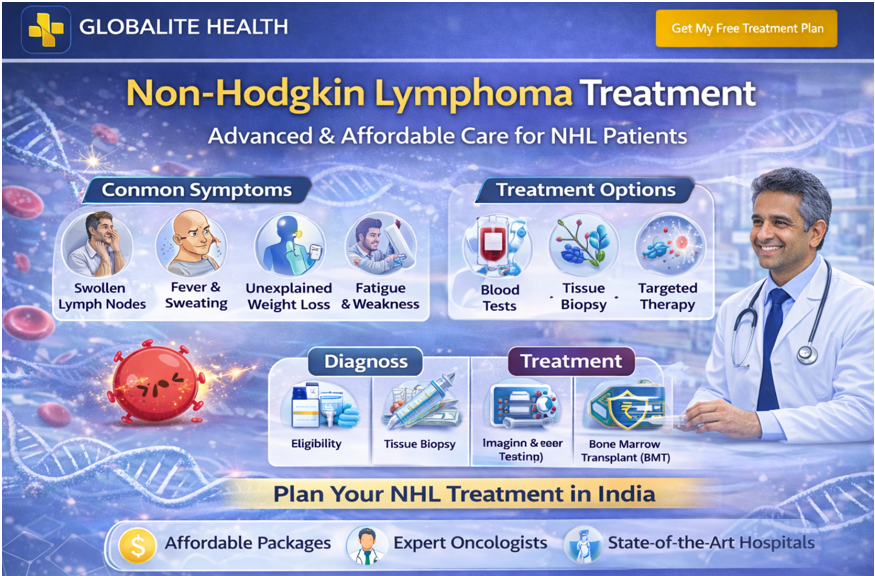
Non-Hodgkin Lymphoma (NHL) is a group of blood cancers that start in the lymphatic system (your body’s infection-fighting network). NHL is not one single disease—there are 60+ recognized subtypes, and treatment is planned based on the exact subtype, stage, and how fast it is growing.¹
For many patients from Kenya, Ghana, Ethiopia, Uganda, Cameroon, Tanzania, and other African countries, the biggest challenges are: late diagnosis, limited access to PET-CT/molecular testing, high drug costs, and lack of transplant/CAR-T centers. India has become a preferred destination because it combines specialist hematology teams, modern diagnostics, and advanced therapies—often at a much lower total cost than many other countries.
What Is Non-Hodgkin Lymphoma?
NHL is a cancer of lymphocytes (a type of white blood cell). It usually starts from:
- B-cells (most common)
- T-cells (less common, often more complex)
In NHL, abnormal lymphocytes multiply, collect in lymph nodes or organs, and weaken immunity.
Common Types of Non-Hodgkin Lymphoma
Because NHL has many subtypes, doctors first classify it as indolent (slow-growing) or aggressive (fast-growing), then confirm the exact subtype.
Common B-cell NHL subtypes
- Diffuse Large B-Cell Lymphoma (DLBCL) (aggressive; common)
- Follicular Lymphoma (indolent)
- Mantle Cell Lymphoma (often aggressive)
- Marginal Zone Lymphoma (often indolent)
- Burkitt Lymphoma (very aggressive; urgent treatment)
Common T-cell NHL subtypes
- Peripheral T-Cell Lymphoma (PTCL)
- Cutaneous T-Cell Lymphoma (CTCL)
Symptoms of Non-Hodgkin Lymphoma
NHL symptoms depend on where it is in the body and how fast it is growing. Many patients notice:
1) Swollen lymph nodes (most common)
- Neck, armpit, groin
Often painless, gradually increasing.²
2) “B symptoms” (important red flags)
- Unexplained fever
- Drenching night sweats
- Unexplained weight loss
These “B symptoms” are clinically important for staging and prognosis.³
3) Site-specific symptoms (based on location)
- Chest: cough, breathlessness, chest pressure
- Abdomen: fullness, pain, reduced appetite (enlarged spleen/liver)
- Bone marrow: fatigue/anemia, frequent infections, easy bruising/bleeding
✅ See a hematologist urgently if swelling lasts >2 weeks, or if fever/night sweats/weight loss happen together.
How Non-Hodgkin Lymphoma Is Diagnosed
Accurate diagnosis is everything in NHL—because subtype decides treatment.
Core tests usually include:
- Lymph node biopsy (gold standard)
- Immunohistochemistry (IHC) / Flow cytometry (cell markers like CD20, CD3)
- PET-CT / CT scans (staging and response)
- Bone marrow biopsy (if marrow involvement suspected)
- Genetic/molecular tests (FISH/PCR/NGS in selected cases)
Staging of Non-Hodgkin Lymphoma (Simple View)
Doctors typically stage NHL from Stage I to Stage IV:
- Stage I–II: localized (fewer areas)
- Stage III–IV: more widespread (both sides of diaphragm / organs)
Early detection matters a lot: SEER data shows stage-wise survival differences (example: Stage I has much higher 5-year relative survival than Stage IV).⁴
Treatment Options for Non-Hodgkin Lymphoma
Treatment depends on subtype + stage + patient fitness.
1) Watchful Waiting (for some slow lymphomas)
Some indolent NHL types may be monitored until symptoms or progression appear.
2) Chemotherapy + Immunotherapy
For many B-cell lymphomas, chemo-immunotherapy is the backbone.
R-CHOP is a common regimen for DLBCL and several B-cell NHLs and includes:
Rituximab + Cyclophosphamide + Doxorubicin + Vincristine + Prednisone.⁵
3) Targeted Therapy
Oral/IV drugs that target cancer pathways (used in selected subtypes), such as:
- BTK inhibitors (e.g., for mantle cell/CLL-SLL)
- BCL-2 inhibitors, PI3K inhibitors (depending on subtype and prior therapy)
4) Radiation Therapy
Used for selected localized disease or symptom control.
5) Stem Cell Transplant (Bone Marrow Transplant)
Often recommended for:
- Relapsed/refractory NHL
- Some high-risk aggressive lymphomas
Types: Autologous (own cells) or Allogeneic (donor).
6) CAR T-Cell Therapy (for selected relapsed/aggressive NHL)
CAR-T can be considered when lymphoma is relapsed or refractory, especially certain B-cell lymphomas. FDA approvals confirm CAR-T use in relapsed/refractory large B-cell lymphoma after ≥2 lines and as second-line in early relapse/refractory cases, depending on product/indication.⁶
Success Rate of Non-Hodgkin Lymphoma Treatment
“Success” is usually measured as:
- Complete remission
- Progression-free survival
- Overall survival
Because NHL includes many subtypes, success rates vary widely. As a broad reference point, SEER reports an overall 5-year relative survival of 74.2% for NHL (U.S. population data; outcomes differ by subtype, stage, and access to therapy).⁷
Good news: many aggressive lymphomas are potentially curable when treated early and correctly, and indolent lymphomas can often be controlled for years with modern therapy.
Cost of Non-Hodgkin Lymphoma Treatment in India (Estimated)
India’s total cost varies by:
- Subtype (DLBCL vs follicular vs T-cell)
- Stage
- Need for rituximab/targeted drugs
- ICU/complications
- Transplant or CAR-T requirement
Typical estimate range: ₹6,00,000 to ₹30,00,000 (approx. $7,200 to $36,000), with advanced options like transplant/CAR-T costing more.
If you share:
- diagnosis report (biopsy/IHC),
- PET-CT summary,
- and current treatment history,
we can help you plan a clear pathway + transparent estimate before travel.
Why Patients from Africa Choose India for NHL Treatment
Patients from Kenya, Ghana, Ethiopia, Uganda, Cameroon, Tanzania often choose India for:
- Experienced lymphoma teams (hematology + oncology + transplant)
- PET-CT + molecular testing availability
- Chemo-daycare + infection-control units
- Stem cell transplant programs
- Access to CAR-T in selected centers
- Faster scheduling and coordinated international-patient support
What Recovery Looks Like After Treatment
Recovery depends on treatment intensity:
- Chemo / immunotherapy: fatigue, infection risk, appetite changes (weeks to months)
- Targeted therapy: often outpatient; ongoing monitoring
- Transplant: longer recovery (months), infection prevention is critical
- CAR-T: requires close monitoring early for fever/neurologic symptoms (first 1–2 weeks is most sensitive)
Frequently Asked Questions (FAQs)
1) What are the first warning signs of Non-Hodgkin Lymphoma?
Most commonly painless swollen lymph nodes, plus fatigue, fever, night sweats, or weight loss.
2) Is Non-Hodgkin Lymphoma curable?
Some aggressive NHL subtypes can be curable, especially when treated early. Indolent lymphomas are often highly controllable long-term.
3) What is the best treatment for NHL?
There isn’t one “best” treatment for all. The best plan depends on subtype, stage, and patient health. Many B-cell NHLs use chemo-immunotherapy (example: R-CHOP).⁵
4) When is stem cell transplant needed in NHL?
Commonly for relapsed/refractory disease, or selected high-risk aggressive cases after response to salvage therapy.
5) When is CAR T-cell therapy used in NHL?
Usually when NHL is relapsed or refractory after prior lines of therapy, especially in certain B-cell lymphomas.⁶